
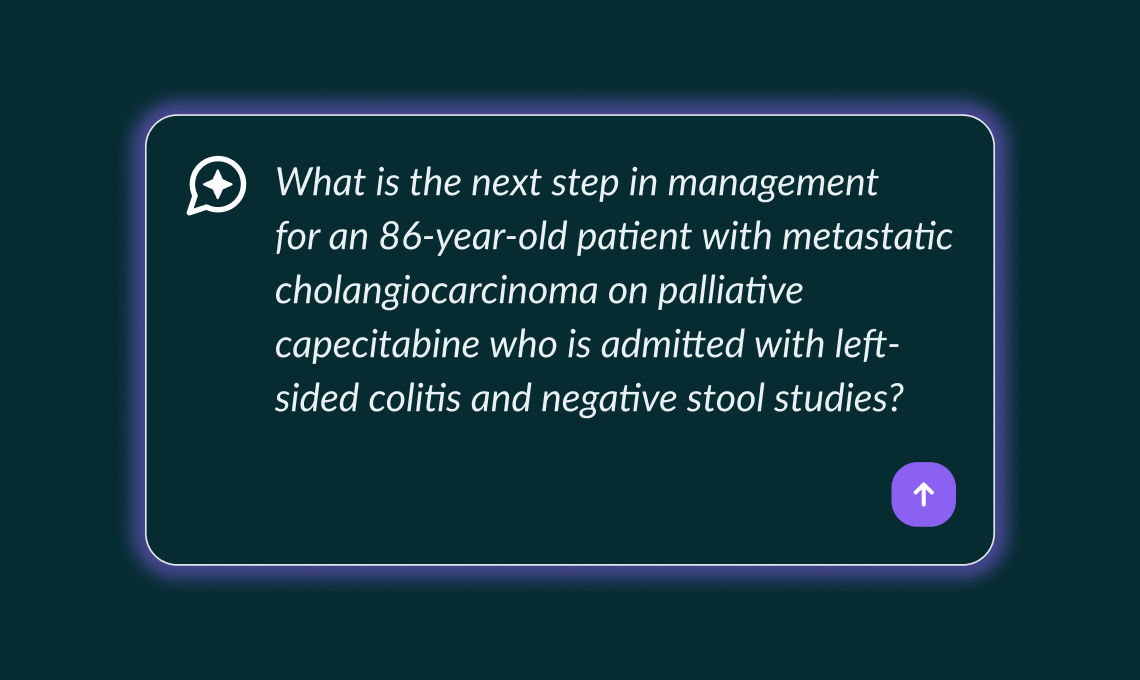


Developed in close collaboration between our experienced clinicians and engineering teams, AMBOSS AI Mode bridges the gap between cutting-edge AI technology and a curated selection of the latest clinical evidence. By focusing on the highest clinical relevance, both in what is presented and how it is presented, AI Mode enhances rather than replaces clinical judgment. AMBOSS AI Mode is designed to help clinicians efficiently navigate existing, trusted knowledge that is tailored to their specialty, and find what they need so that they can make confident, defensible decisions.
AI has fundamentally transformed how clinicians interact with information in every aspect of care. Yet based on the feedback from our hundreds of thousands of users and our own clinical experience, we identified consistent gaps:
We realized that our trusted AMBOSS knowledge base—already distilled from the latest clinical evidence and refined through human expertise, critical evaluation, and clinical consensus—offered a unique opportunity. We also recognize that true value lies not only in the quality of information, but in how clearly and efficiently it’s delivered within clinical workflows.
AI Mode’s architecture differs fundamentally from other AI solutions. To ensure clinical relevance, we deliberately limit sources to the AMBOSS knowledge base, a continuously updated and curated selection of clinical US guidelines, and a comprehensive drug database.
Our editorial team has long specialized in translating clinical evidence into actionable guidance. Through our proven structure, we highlight key steps and provide clear, concise recommendations that are easy to understand and apply, always focusing on what matters most for real-world medicine.
This same expertise now shapes AMBOSS AI Mode. Based on a clinical question or scenario, it finds relevant information and provides a clear, well-structured, and summarized response that directs clinicians to relevant sources. AI Mode also anticipates related questions, surfacing further evidence so that clinicians can consider aspects beyond the initial query. AI Mode doesn’t replace clinical judgment; it rather enhances it, highlighting every nuance of the evidence to support decision-making.
Developing AMBOSS AI Mode reaffirmed something we’ve always known: Trust in AI must be earned through transparency, not claimed through promises. That’s why we heavily invested in the development of internal benchmarks, continuously tested AI Mode against them, and provided access to our model (LiSA 1.0) for external studies to perform independent evaluation.
Throughout this process, one principle remained constant: never compromising the trust that clinicians place in AMBOSS. To minimize the risk of hallucinations, AI Mode’s access is intentionally limited to high-quality, clinically relevant sources, and it is trained to clearly indicate if available information is insufficient.
We also deepened our understanding of what clinicians expect from AI in practice: fast, reliable evidence tailored to their workflow and medical field. AI Mode transparently highlights differing recommendations, and adapts the responses to each specialty so that the context always matches the user’s perspective.
AI Mode builds directly on what has always defined AMBOSS: actionable, evidence-based medical knowledge, refined by clinicians. What’s changing with AI Mode is how that knowledge can be accessed and experienced. AI Mode is a new way of interacting with trusted content through AI-powered search that processes clinical questions and scenarios phrased in natural language, and connects them to verified medical knowledge. This hybrid model combines the best of both worlds:
All active AMBOSS members in the US will soon be able to access AMBOSS AI Mode as part of their membership. In one seamless experience, they will be able to move fluidly between dynamic outputs and trusted reference material.
Access will be introduced in limited phases, beginning with our most engaged AMBOSS members in the US to give them the first opportunity to experience AI Mode in their daily practice. Interested clinicians can sign up for launch updates. We will share more details as the rollout continues.
We’re proud of this step and excited about the opportunities AMBOSS AI Mode opens up for clinical care. At the same time, we’re looking ahead: Our roadmap includes more advanced personalization to make AI Mode even more effective.
This approach also signals how we see AI fitting into clinical care: helping clinicians to efficiently identify, access, and apply trusted clinical evidence tailored to their needs, enabling confident, defensible decisions. This is a different philosophy from much of what’s happening in the AI health care space right now, and it’s one that we are committed to exploring.





© 2026 AMBOSS. All rights reserved.