
Never Too Late: How Dr. Hernando Baez Matched at his Top-Choice US Pediatric Residency More Than 5 Years After Graduation
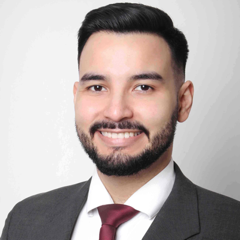
Hernando Baez
Pediatrician and Medical Educator
IMG from Paraguay
Can you match after a five-year graduation gap?
The short answer is, yes, but it requires a shift in mindset and a commitment to demonstrating clinical seriousness. Hernando recognized that programs evaluate candidates holistically, looking for passion and character, not just raw scores.
“I truly have an intuition that if I go through the pathway and make my best effort to be able to demonstrate that I'm serious about pediatrics and about training again, that some program will notice and I will be able to get into a US residency.”
To make up for the five-year graduation gap, Hernando didn't just study, he immersed himself in the system, and recommends that every IMG first engage in an observer experience to ensure the US medical system aligns with their goals. This clinical commitment became the backbone of his compelling narrative.
What is the best way to approach studying years after graduation?
For Hernando, the challenge was recalling clinical subjects he hadn’t studied in nearly a decade. He decided to move away from passive reading and embrace the “test effect”: the concept that information is retained longer when introduced through a question rather than a textbook.
“I jumped straight to the questions on AMBOSS. If I got a question wrong, it didn’t matter, because the platform explained what I needed to know to answer the question, not only the explanation of the right answer. So in that way, I was learning from my mistakes.”
He treated the AMBOSS Qbank as his primary study tool, taking two passes at Step 1. The first pass was a deep dive into every explanation to build test-taking skills, while the second pass focused on speed and high-volume repetition.
Having all USMLE Step 1, Step 2, and Step 3 resources on one platform also helped Hernando prepare for the exams efficiently. By using AMBOSS throughout his journey, he found that the Steps were not separate silos, but a continuous development of medical knowledge.
-
- Step-specific customization: AMBOSS highlights information based on the exam (Step 1 or Step 2), emphasizing the most relevant details.
- Foundation access: While preparing for Step 3, Hernando could easily toggle back to Step 1 foundational concepts to bridge any knowledge gaps.
Clinical preparation: The clinical scenarios in AMBOSS questions helped Hernando apply Step 1 theory to his daily practice and patient care.
Prep for the USMLE in One Comprehensive Platform
Learn effectively, from USMLE Step 1, 2, and 3, all the way to clinical practice, in a single integrated system.
.png)
Can a five-year gap actually be an advantage?
Instead of hiding his five-year gap, Hernando used it as a strength. During his interviews, he leaned into his experience as a pediatrician and a university medical educator in Paraguay to demonstrate his leadership skills.
He proved that while the USMLE tests medical knowledge, the years spent in clinical practice build the passion and character that residency directors are actually looking for.
“I truly have an intuition that if I go through the pathway and make my best effort to be able to demonstrate that I'm serious about pediatrics and about training again, that some program will notice and I will be able to get into a US residency.”
Hernando’s journey from a hospital educator in Paraguay to a resident at Holtz Children’s Hospital proves that with the right resources and a clear narrative, it’s never too late to achieve your goals.