From Rural Physician in India to Radiology Resident in Minnesota: How Dr. Anna Scored 275 on USMLE® Step 2
Dr. Anna Menezes, an international medical graduate (IMG) from India, achieved a score of 275 on USMLE Step 2 and a first-attempt pass on Step 1. Incredibly, she managed to achieve all this while working as a full-time rural physician. She used AMBOSS as her sole resource for Step 1 and the primary tool for Step 2 to master the process of elimination strategy required for the NBME® exam. Her experience proves that a single, integrated resource is key to achieving a top-tier USMLE score while maintaining a busy clinical schedule.

Dr. Anna Menezes
Resident (PGY-2 Diagnostic Radiology), Minnesota
IMG from Bangalore, India
How to transition from Indian medical exams to the USMLE
For many IMGs, the most significant barrier is not a lack of medical knowledge but that the USMLE has a fundamentally different testing framework from exams in their home countries. This is the case for IMGs in India who plan to take the USMLE.
Anna noted that the exams she took in India were primarily factual, often asking memory-based questions such as, “Who named this?” or “What is the length of this structure?” In contrast, the USMLE is deeply analytical, requiring students to determine the next step in diagnosis or management rather than simply regurgitating facts.
“Training your brain to think analytically is very different from training your brain to think factually.”
To bridge this gap and adjust to this new testing framework, Anna practiced with the difficulty-graded questions in the AMBOSS Qbank, starting with easier questions (1–3 hammers) to build confidence and understanding before tackling the harder questions (4–5 hammers), which test deep analytical concepts.
What strategies can help maximize USMLE preparation with Qbanks?
Dr. Anna scored 275 on Step 2, far exceeding her practice test predictions. She attributes this to understanding how the NBME asks questions, noting that the AMBOSS Qbank was the resource that most accurately reflected the NBME style and best trained her to tackle it.
The key was mastering the “process of elimination” strategy. She said that on the actual exam, students are often stuck between two key answers, and figuring out which one to rule out is key to answering correctly.
To prepare for this, she used the explanations for incorrect options to understand why a distractor was wrong. By clicking the link to the article provided in the explanation, she could then dive deeper into the topic by reading the corresponding AMBOSS article, effectively helping her build a mind map that prevented second-guessing on test day.
Turn Your Clinical Shifts into Top-Tier USMLE Prep
Use AMBOSS content and tools for your clinical encounters and jump directly to relevant USMLE prep material.
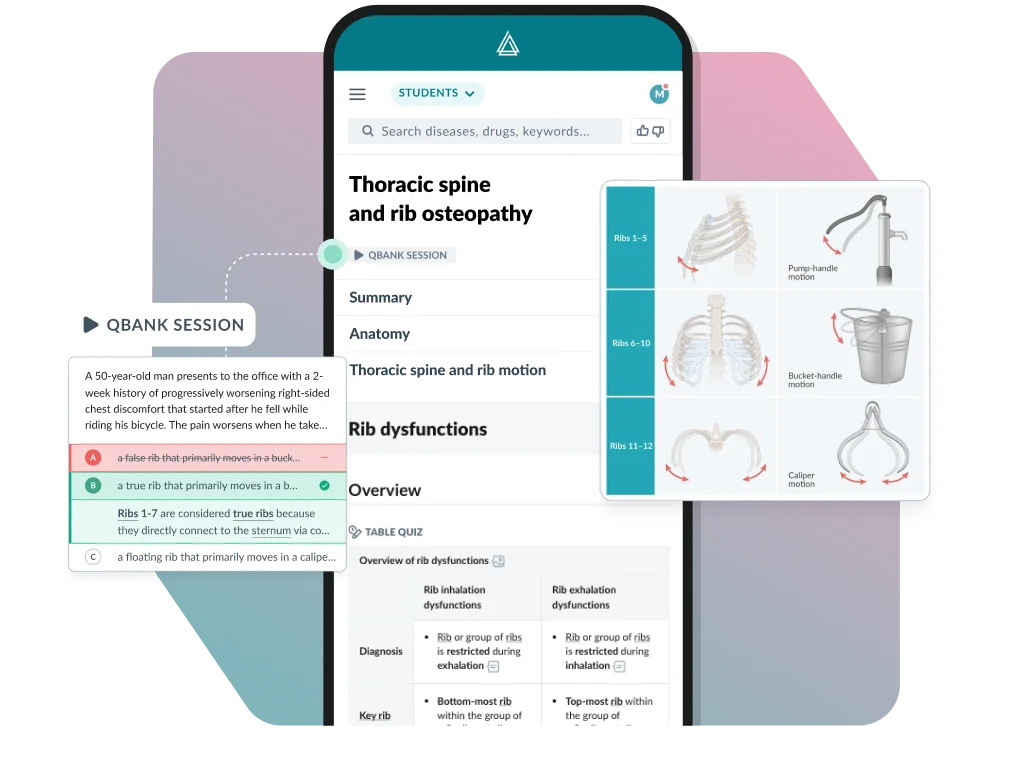
Is it possible to study for the USMLE while working full-time?
Anna did not have the luxury of a dedicated preparation period because she was working full-time as a physician in a rural health care center. This meant she didn’t have time to use multiple resources.
She maximized her limited schedule by using AMBOSS’ clinical content and tools during all her clinical encounters and linking directly to the relevant exam prep material. For example, after treating a patient with a rare case of neurofibromatosis in her clinic, she immediately studied the corresponding AMBOSS article and questions to “seal” the knowledge. In a way, working full-time helped her prepare for the USMLE even more.
To turn short work breaks into quick study sessions, she relied on the Key exam info feature to focus strictly on high-yield, exam-relevant information.
Is AMBOSS enough to prepare for the USMLE?
A common anxiety for IMGs is “resource overload:” the belief that they have to use every available question bank to pass. Anna debunks this myth entirely, as she exclusively used AMBOSS to prepare for Step 1 and passed comfortably, proving that a single, comprehensive resource is sufficient when used correctly.
“My whole Step 1 [prep] was just AMBOSS. No other question bank. It was just the AMBOSS Library and Question Bank.”
She advises students to trust themselves rather than following the crowd. She found that other question banks often tried to trick her into thinking the answer was a rare disease, whereas AMBOSS streamlined her thinking toward the clinical logic required for the exam.
Does AMBOSS help during residency and the Match?
The value of this analytical training through AMBOSS extended well beyond the exam center.
When Anna began her residency in the US, she found that the clinical reasoning she developed during her exam prep translated directly to patient care. During her intern year rotations in the ICU and Emergency Medicine department, she continued to rely on Clinician mode in AMBOSS.
The flowcharts and management guidelines she had studied for the exam helped her manage real patients, from verifying the drip rate for a specific medication to deciding between hydralazine and labetalol for a patient with hypertension.
“AMBOSS really helped me because it taught me not to second-guess myself.”
For Anna, AMBOSS wasn't just a test-prep tool; it helped her transition from being a rural practitioner in India to a confident resident in the US.